
Farewell and fair winds
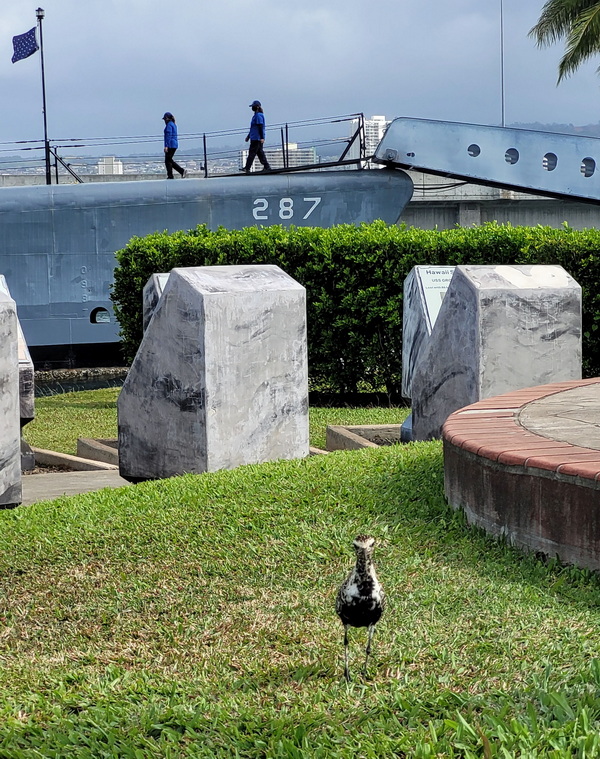 A patriotic plover, April 8, 2022 at the USS Bowfin Submarine Museum and Park. ©David Hyrenbach
May 1, 2022
This is a bittersweet time of year for us plover lovers, since most of Hawai’i’s Kolea (and our other shorebirds) have left the Islands for the Arctic. We wish the birds were still here perking up our lawns and shorelines, and at the same time, admire them for their remarkable, and mandatory, migrations.
Our bird, Jake, had molted almost completely into his spring tuxedo by April 1st, and then proceeded to bulk up day by day. (Craig joked that Jake was going to get too fat to fly.) The last day we saw him, all plump and pretty, was April 17th. Whether he joined his fellow plovers somewhere in Hawai’i or headed directly north, we’ll never know.
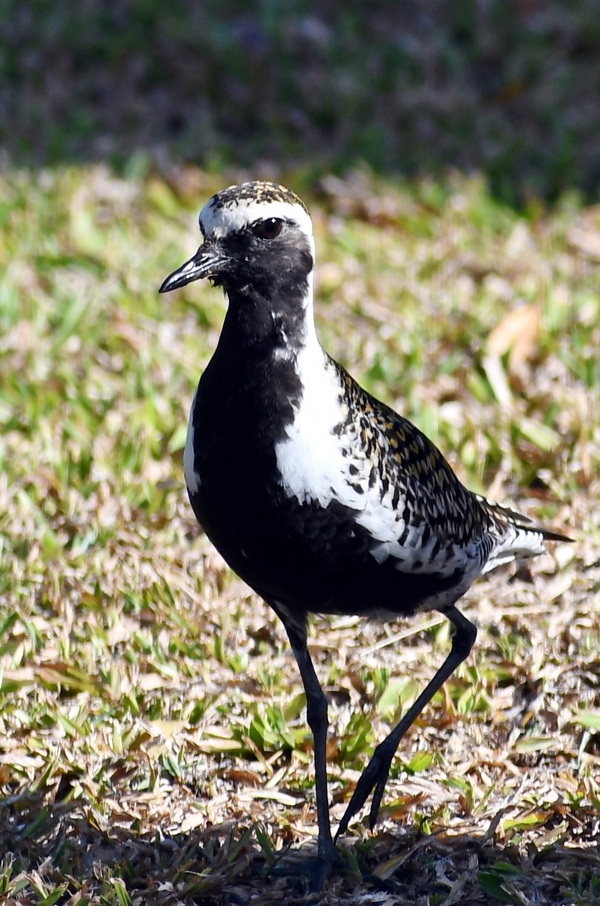 Our Jake on April 1st. ©Susan Scott
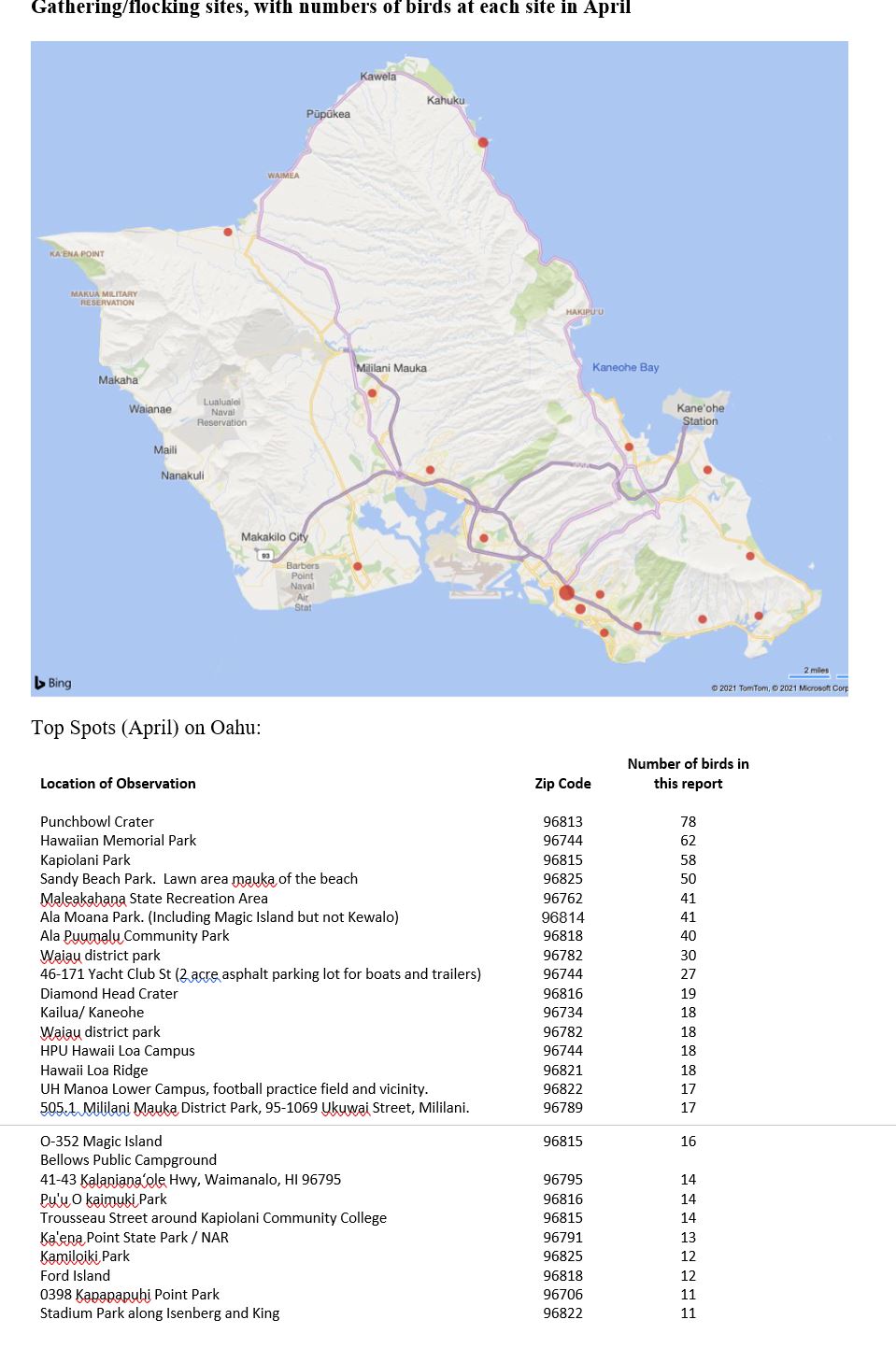
On April 20th, Kolea fan, Roger Kobayashi, kindly escorted me to Ford Island where he has been counting Kolea all winter. The field fronting the NOAA building is a staging area where Kolea gather before departing. I wondered if our Jake was there, a fact we cannot know unless the bird has ID bands on its legs.
Roger counted about 80 Kolea here at the height of the gathering, April 17th, with the number gradually decreasing day by day. Whether the birds took off for their 3,000 mile journey a few at a time, or gathered with others somewhere else in Hawai’i, is unknown.
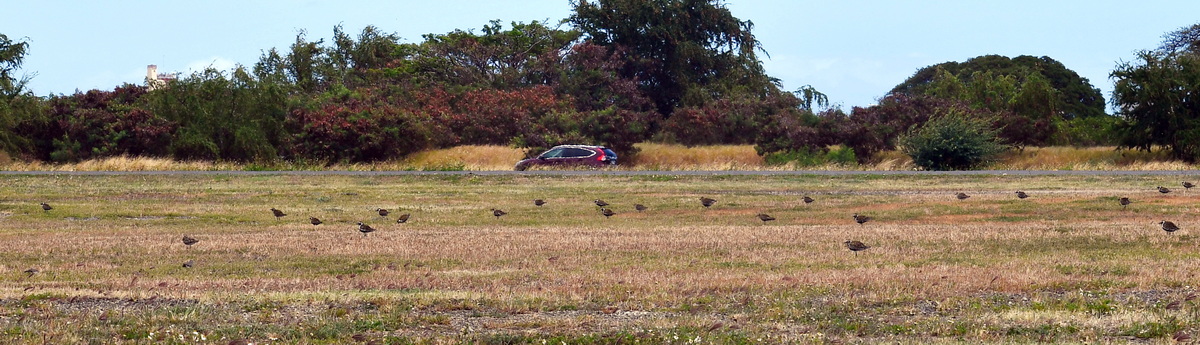 During my visit to the Ford Island field, Roger and I counted about 50 birds in the field. Because they tended to line up lengthwise, less than half are visible in this picture. ©Susan Scott
I visited Punchbowl Cemetery throughout April to check on Wally’s study birds (read here) and found several. Like at Ford Island the number of birds there decreased daily, from the peak of 70, until April 27th. And then there were none.
As of April 27th, Wally reported that 5 of the satellite-tagged birds had already reached Alaska, a 3-day, nonstop flight. He emailed: “Once again, peak departure 24-26 April. Amazing — this has been the exact pattern ever since ’79-80 the first year of our studies in Hawaii!”
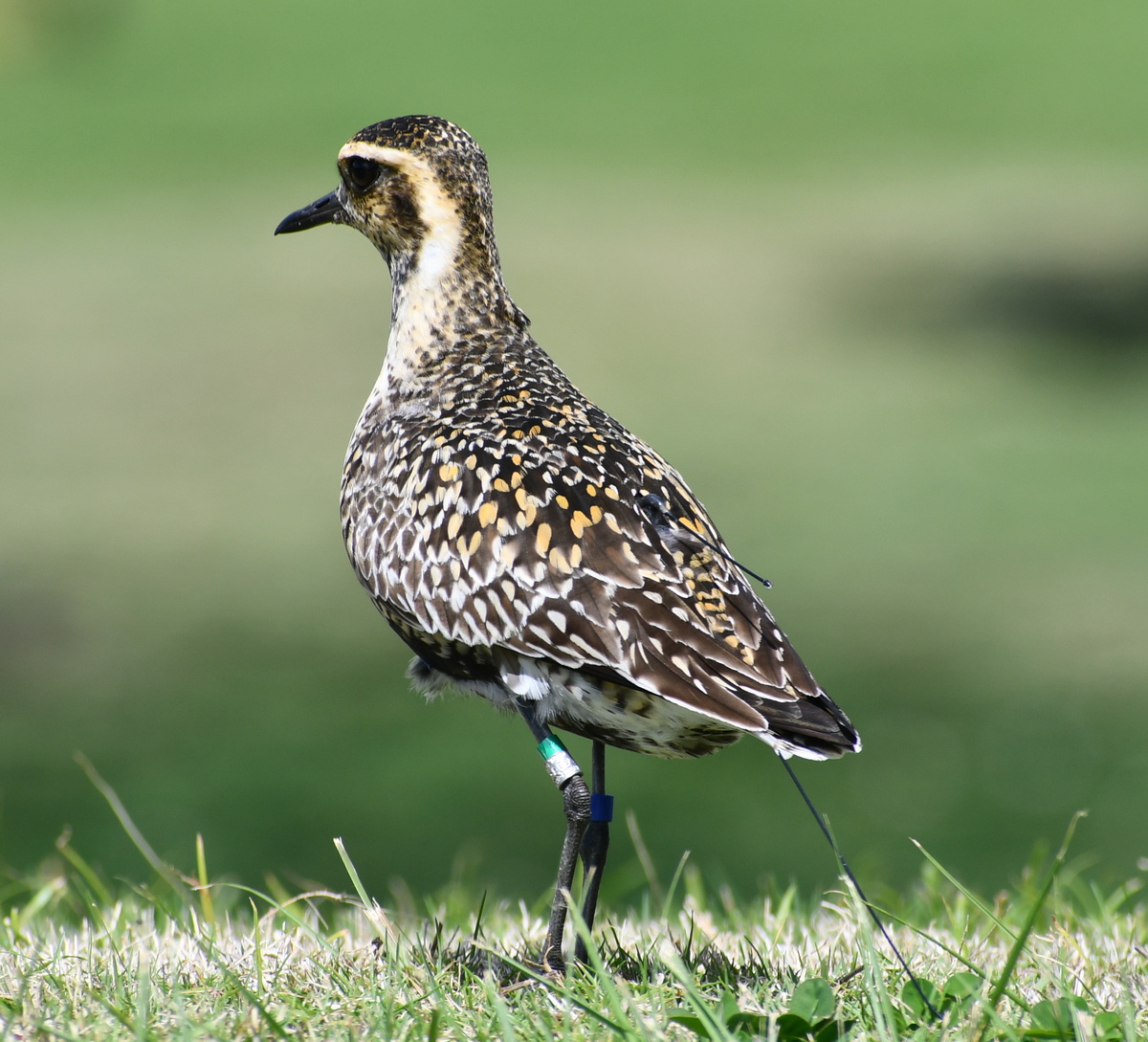 Punchbowl study female, April 20, 2022.©Susan Scott
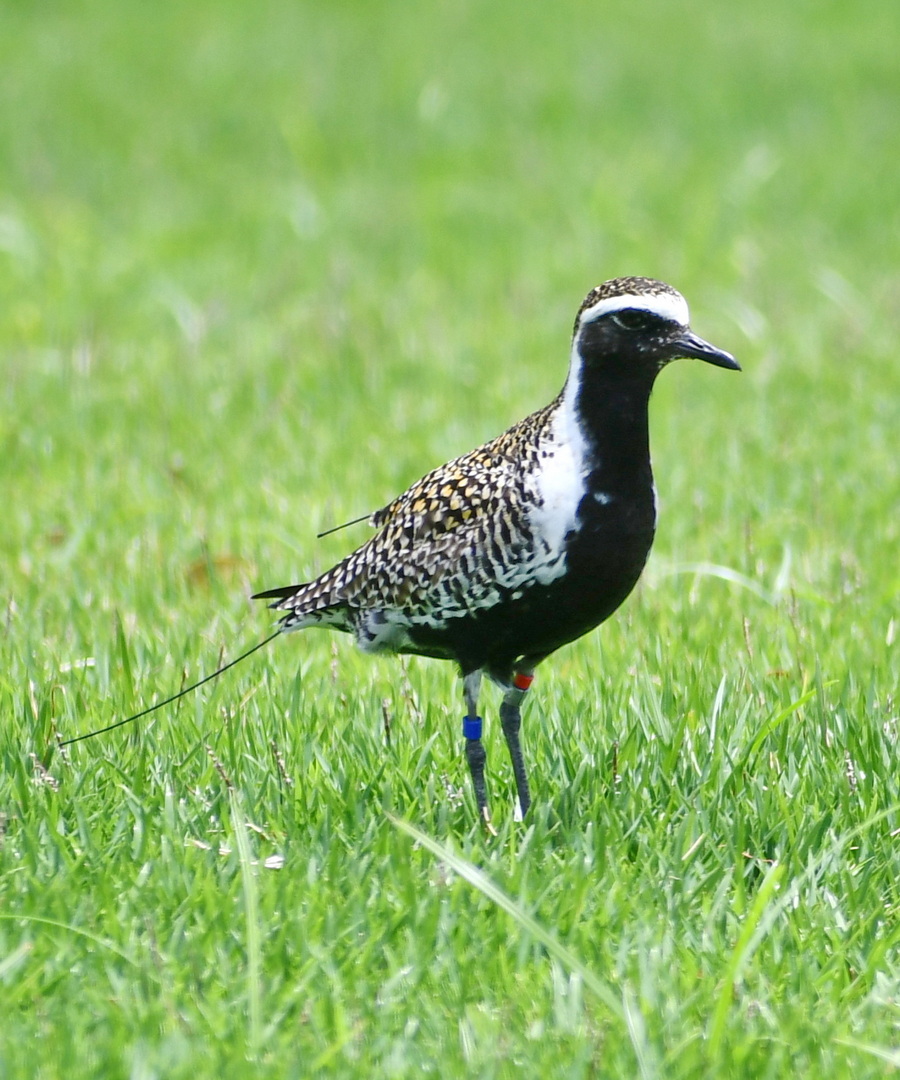 Another Punchbowl study male, April 26, 2022 ©Susan Scott
Wally and other researchers involved in this year’s Kolea study will keep me informed of what’s happening, and I’ll keep you informed here. Analysis of the data we collected for the 2021-2022 Kolea Count is in progress.
In the meantime, please report, and photograph if possible, …
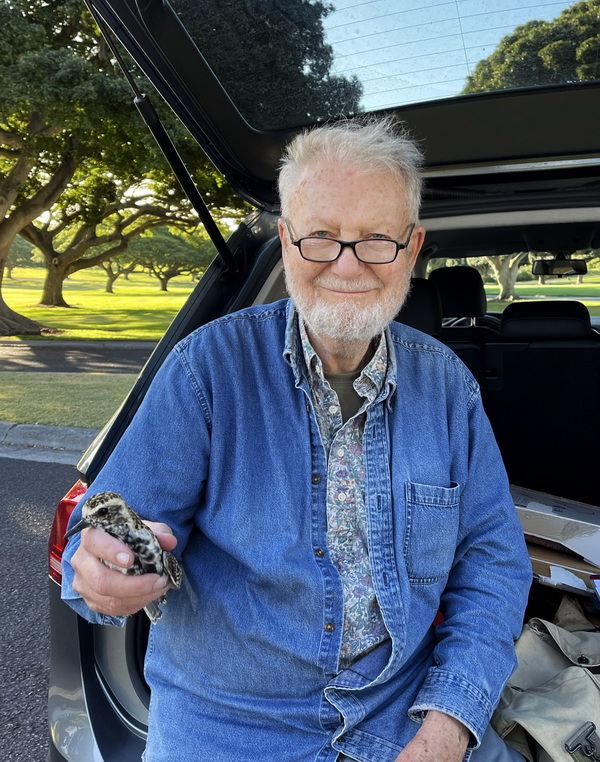
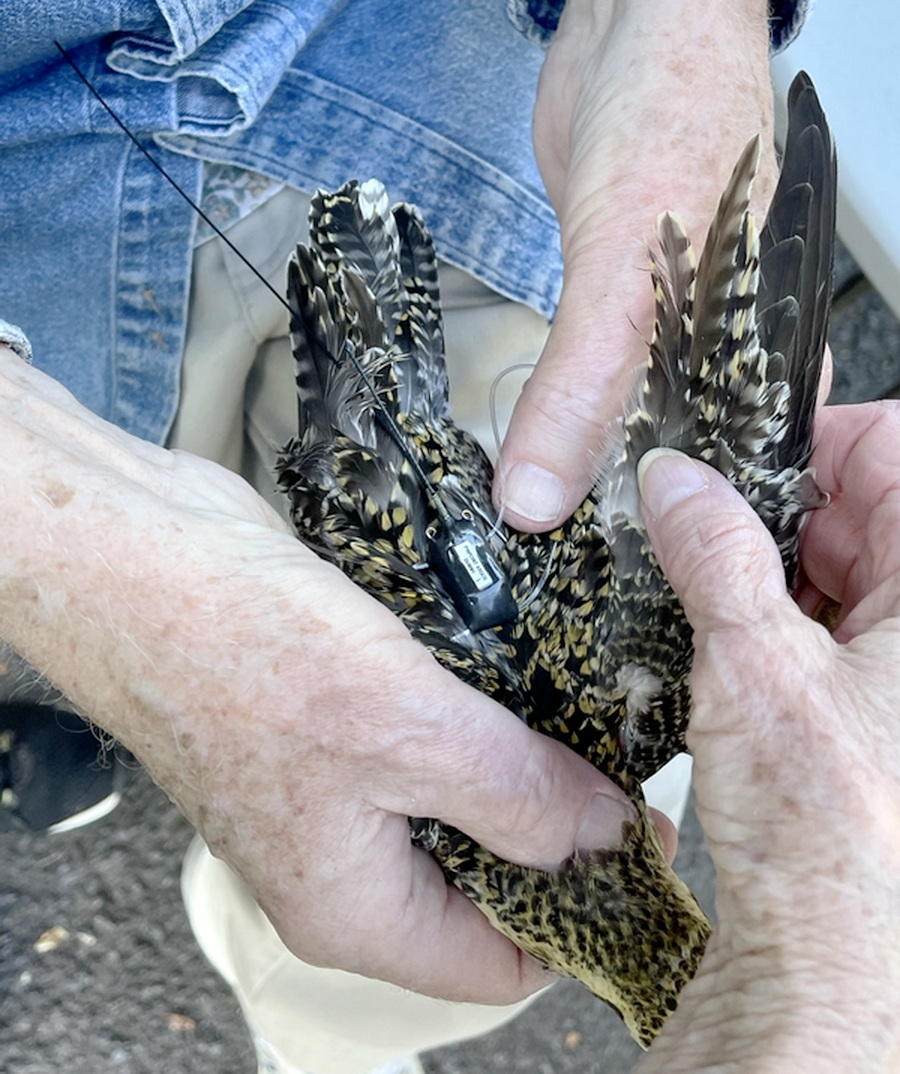 The plover carries its lightweight satellite tag on its back with soft, stretchable straps around the upper part of each leg. This allows the birds to walk and fly unhindered. ©Susan Scott
 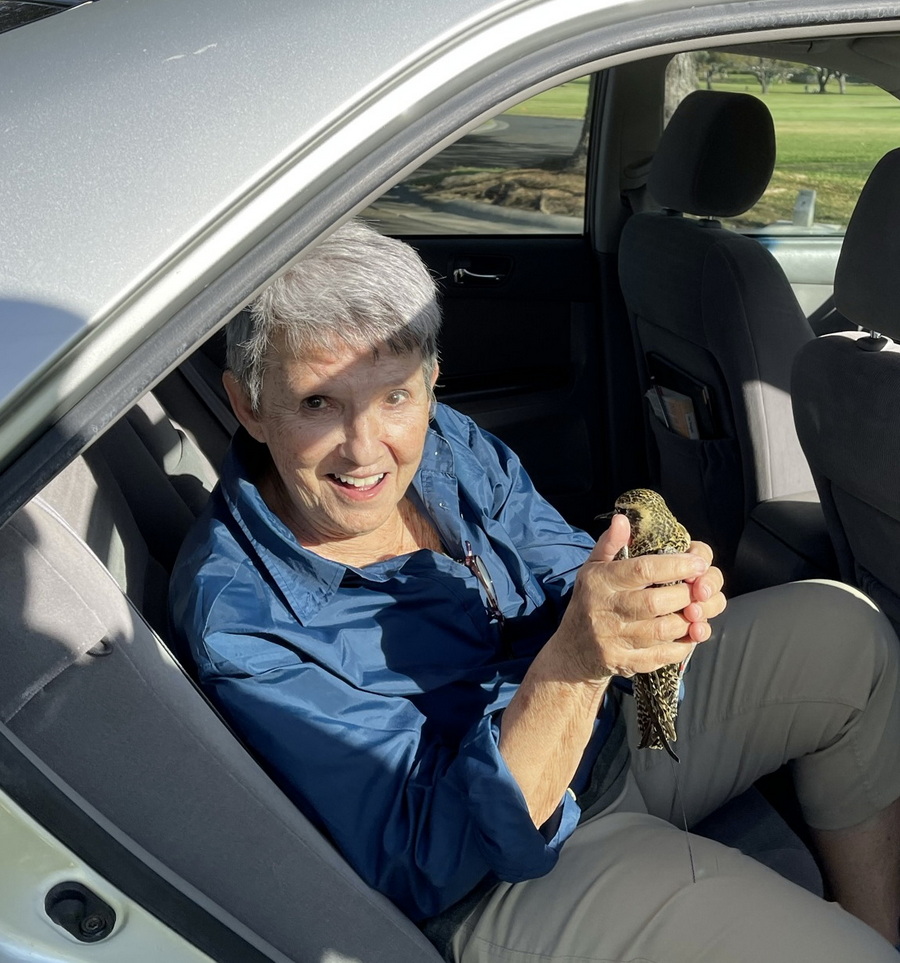 Volunteer, Marcy Katz, enjoys holding a satellite-tagged bird (antenna below its tail) before releasing it. Because Pacific Golden-Plovers defend their foraging areas, Wally makes sure each bird is returned to its home patch to avoid squabbles. ©Susan Scott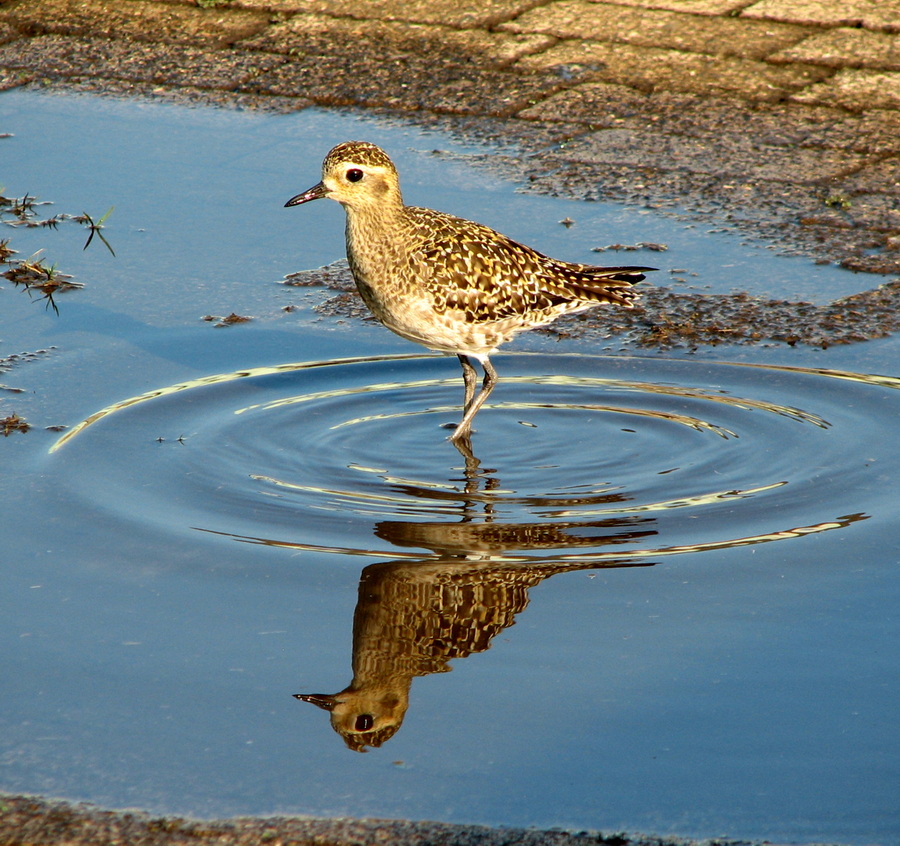
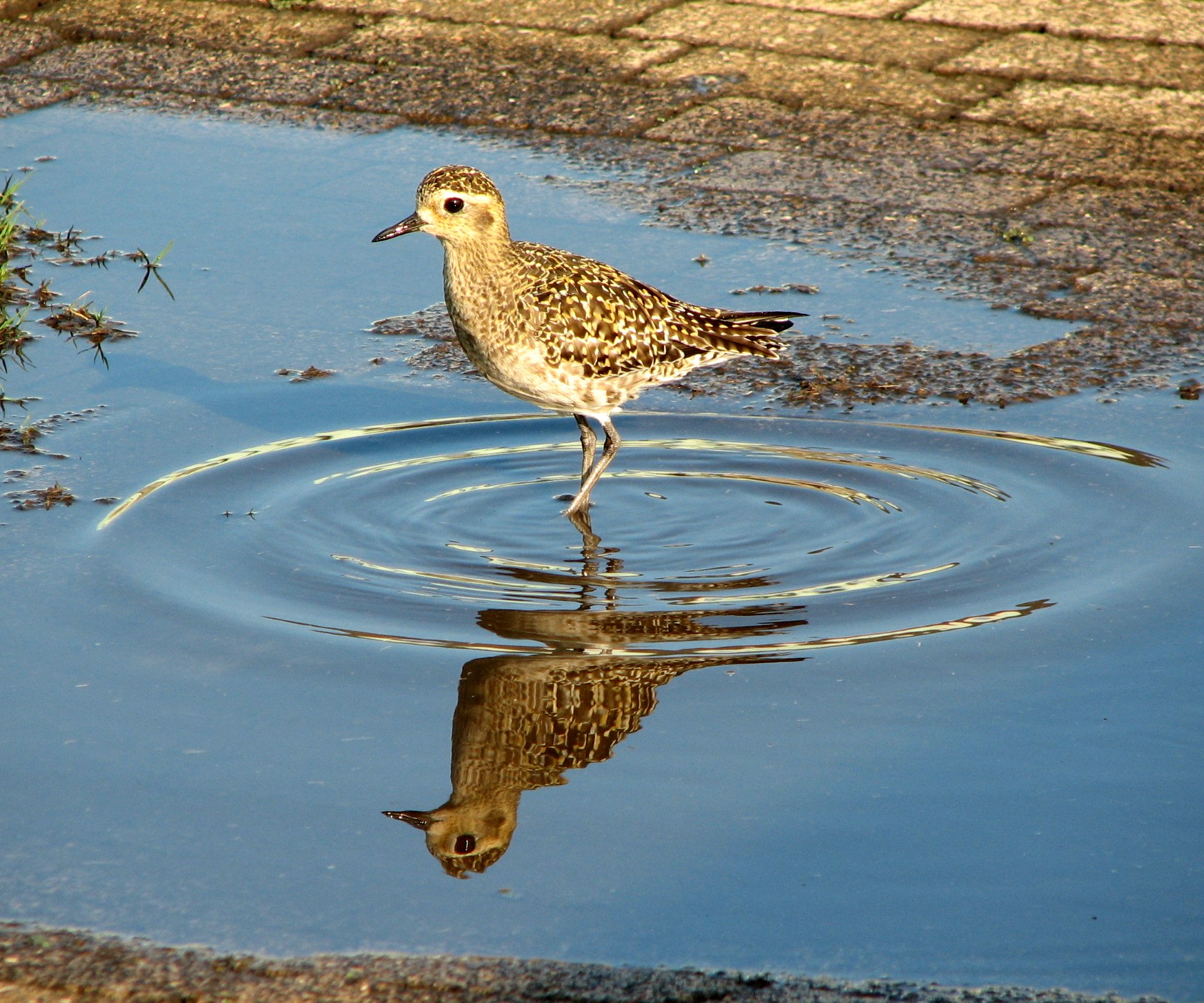 This Maui Kolea enjoyed bathing in a driveway rain puddle. © Photo courtesy Calvin M. Kaya, Ph.D., Professor Emeritus of Biology, Montana State University
 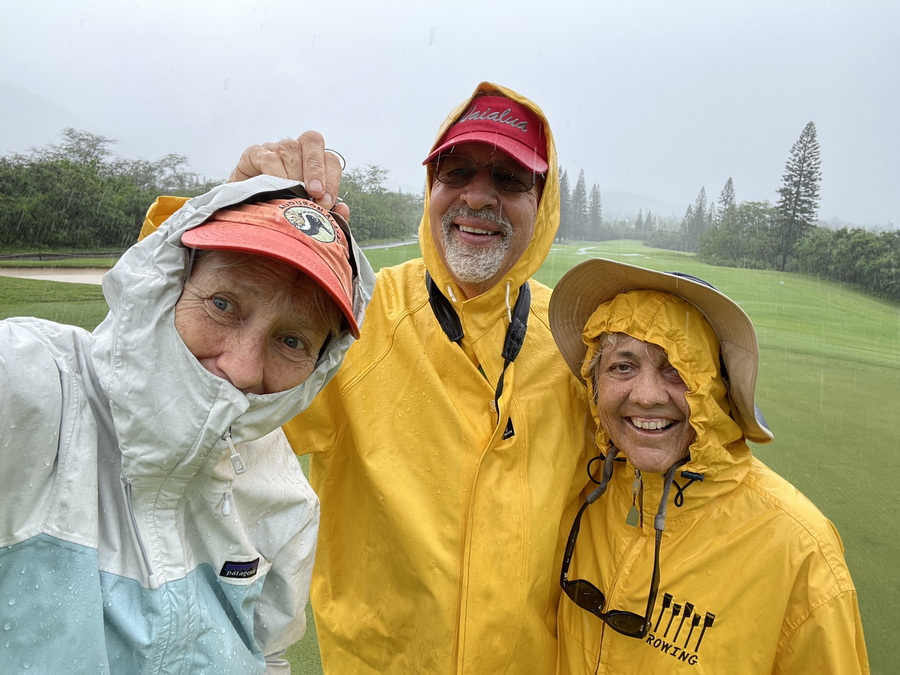 Craig is showing off the Pacific Golden-Plover patch on my Alaska Audubon hat, a special gift. Friend and neighbor Lani Twomey braved the storm to count Kolea with us. (Selfie)
 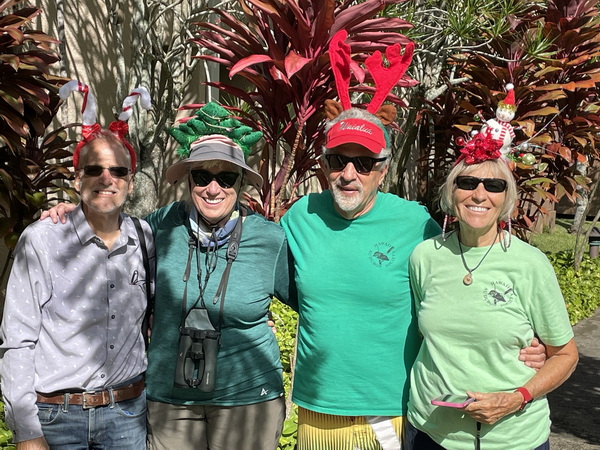 The Christmas Day Kolea team from right, David Johnson. Beth Flint, Craig Thomas and me, Susan Scott. Photo by Michelle Hester
 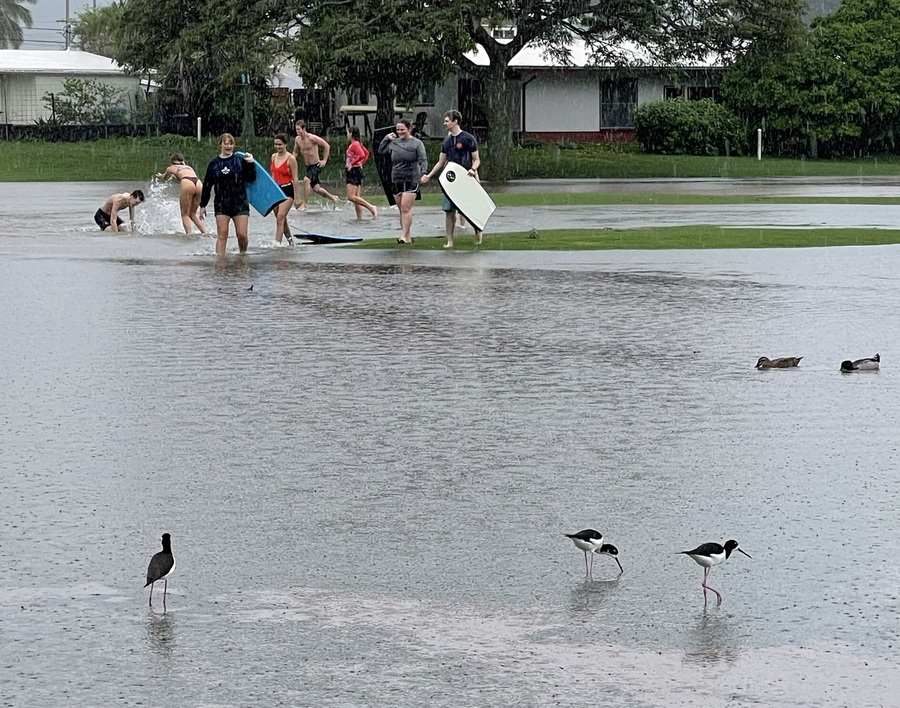 During the storm, stilts, ducks and people enjoyed the temporary lake on this fairway. © Susan Scott
 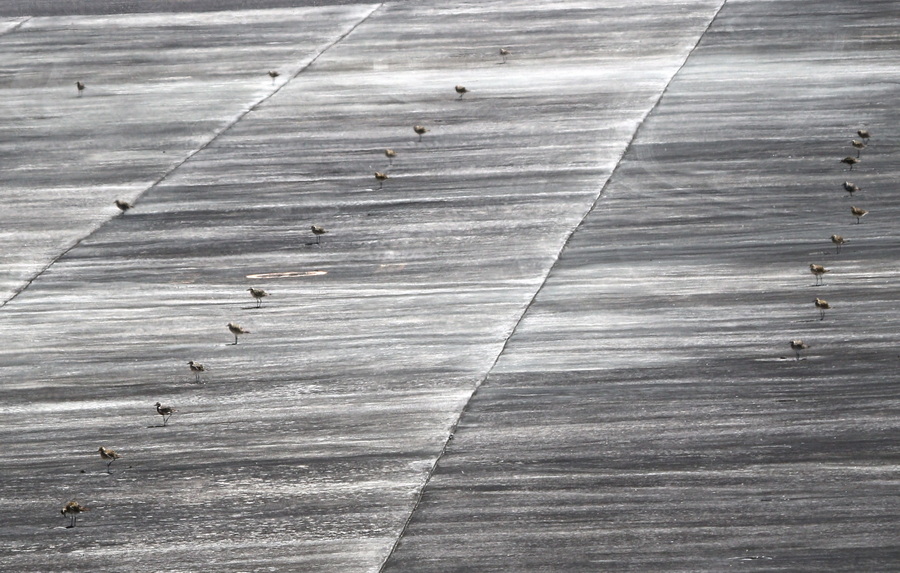 For reasons known only to the Kolea, the birds sometimes line up on the runway at Midway Atoll. © Courtesy Jonathan Plissner, USFWS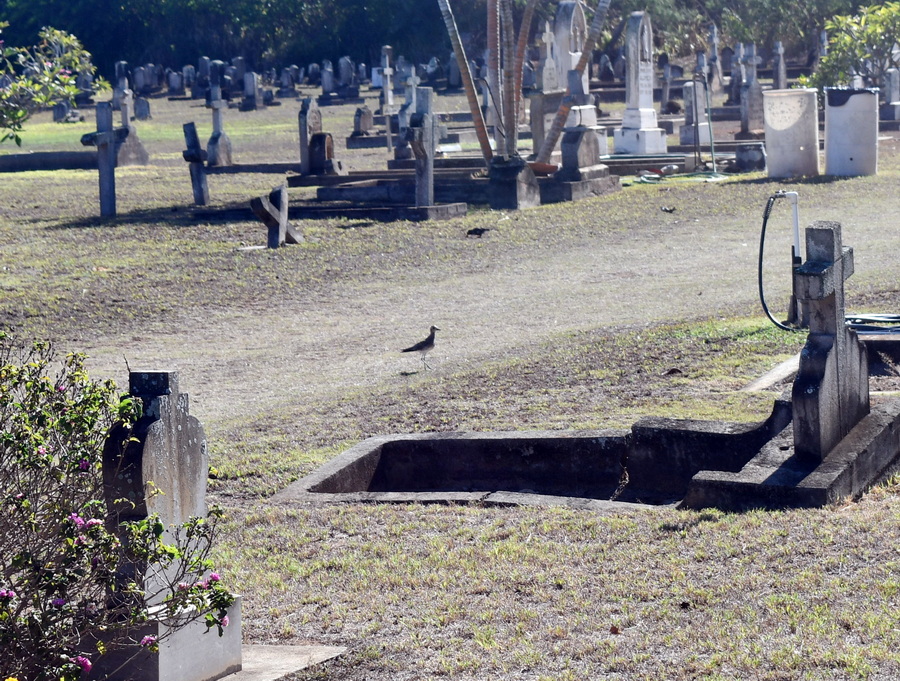
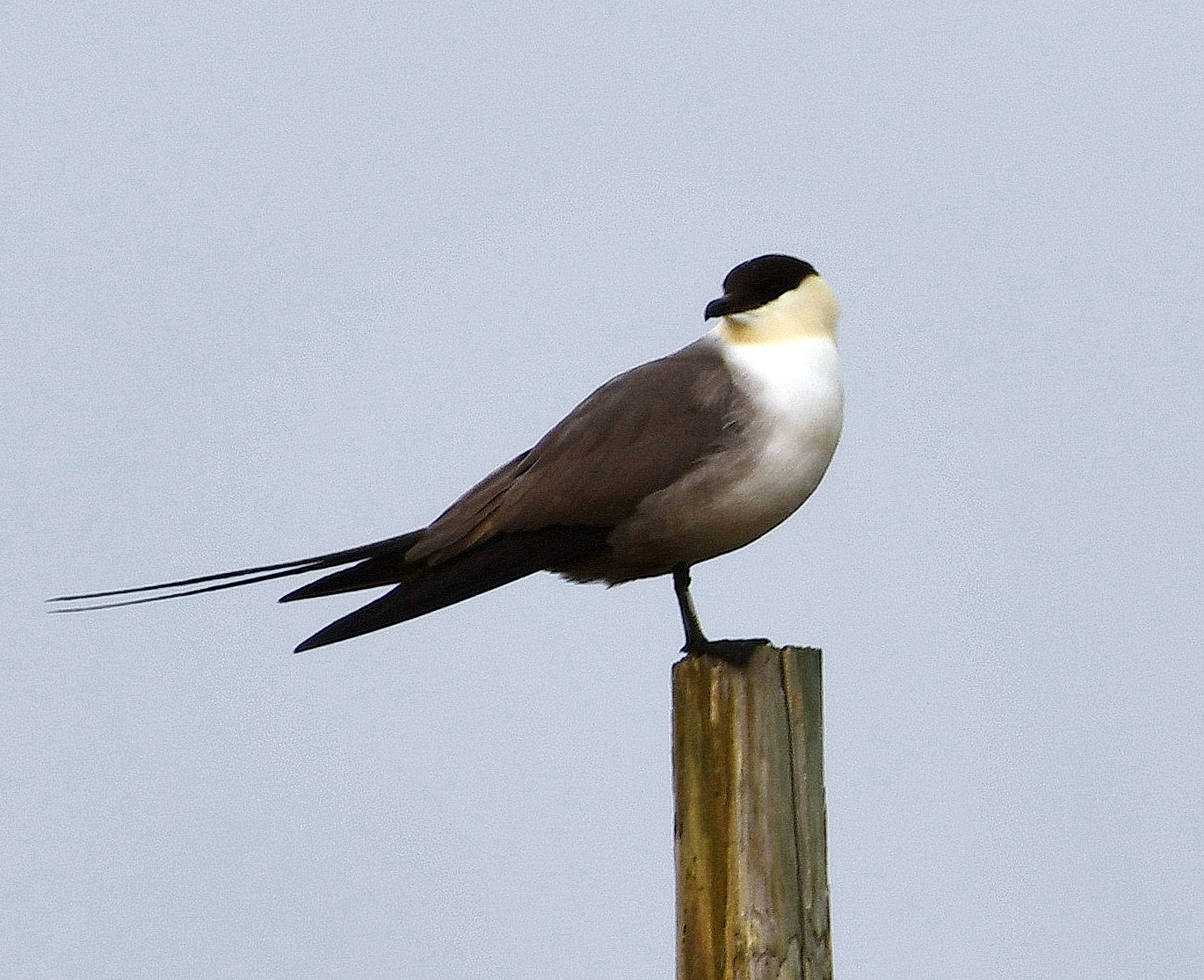 This Jaeger (pronounced YAY-gur, German for hunt) is a fast-flying gull relative that, like Kolea, nests on the ground in the Arctic tundra. Jaegers are predators that eat other birds and their eggs. This post on the tundra outside Nome was a good perch for scouting prey. ©Susan Scott
 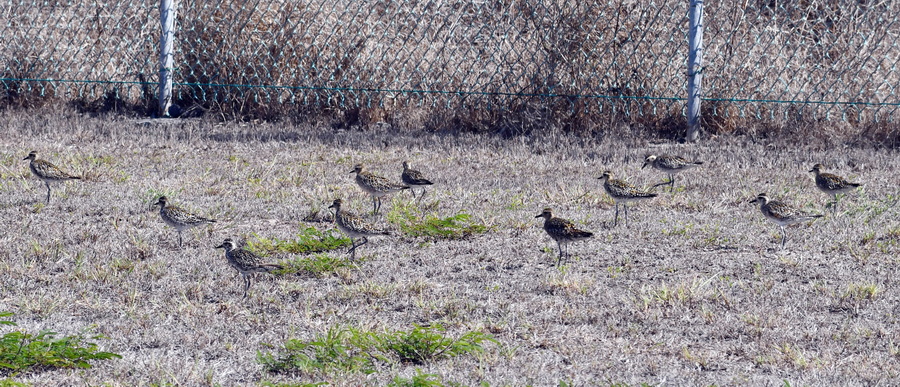 Although usually spread out on the sides of the Dillingham Airfield, these Kolea gathered on on the roadside during sky-diving activities. ©Susan Scott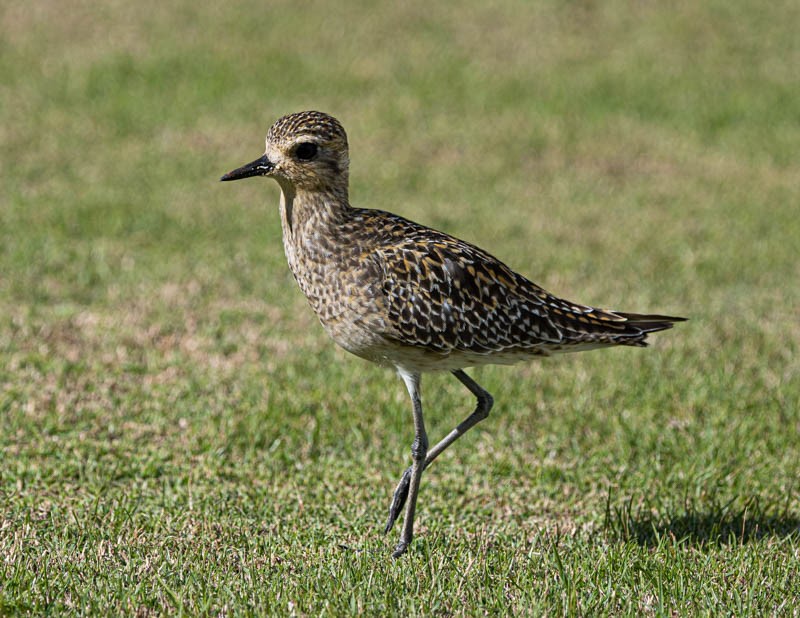
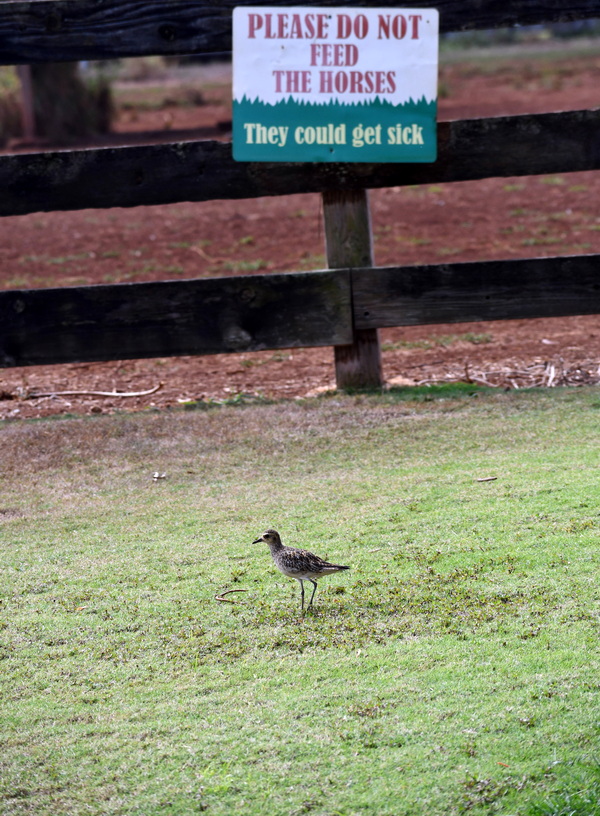 Ms. Ed. ©Susan Scott
 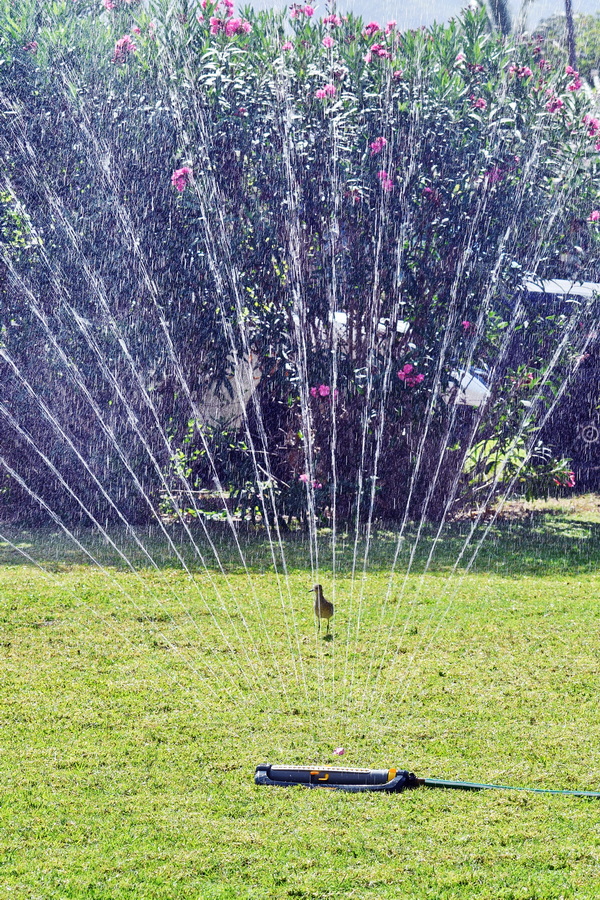 Bilbo taking a shower. ©Susan Scott
 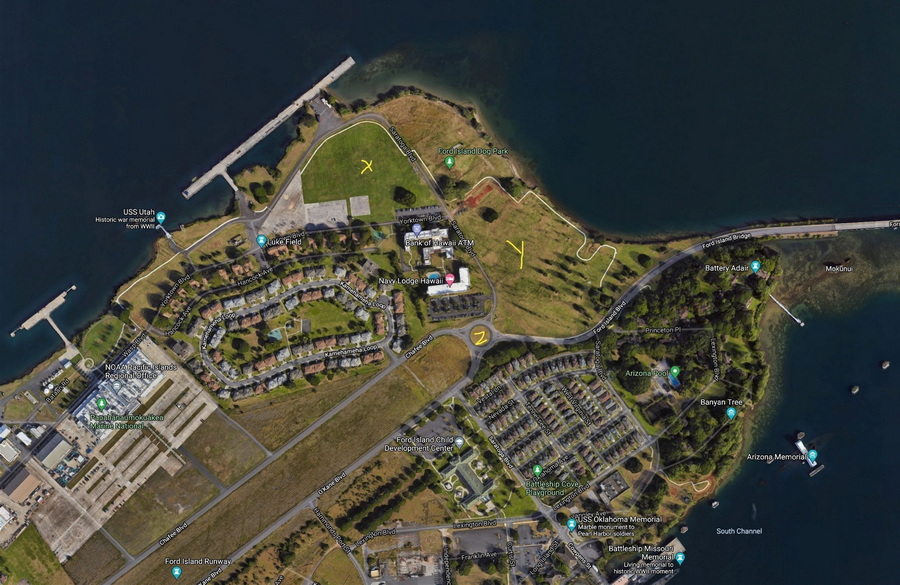 Roger Kobayashi sent a Google map of Ford Island, marking X, Y, and Z as to his first Kolea sightings, August 1, 2021.
 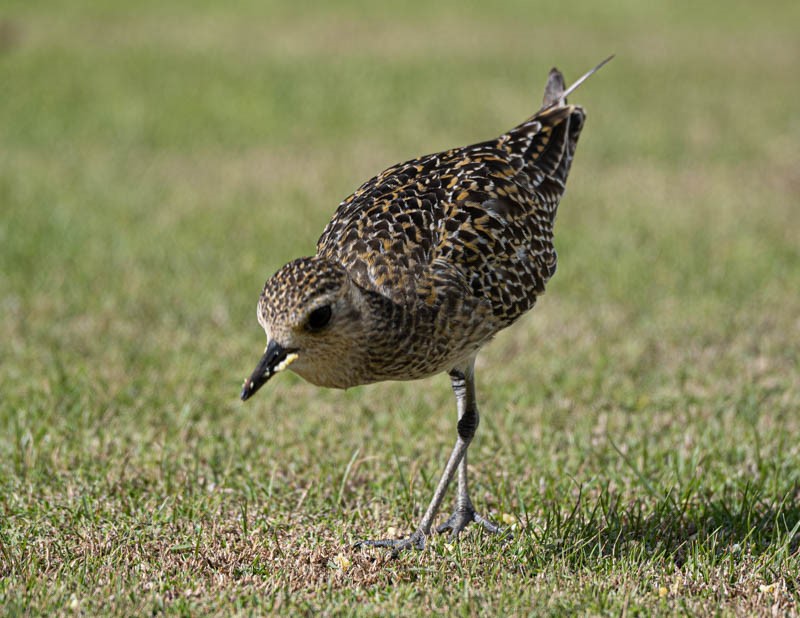 Wally, the bird, enjoying a scrambled egg offering. Please feed your bird only healthy food, such as scrambled egg or mealworms. ©Roger Kobayashi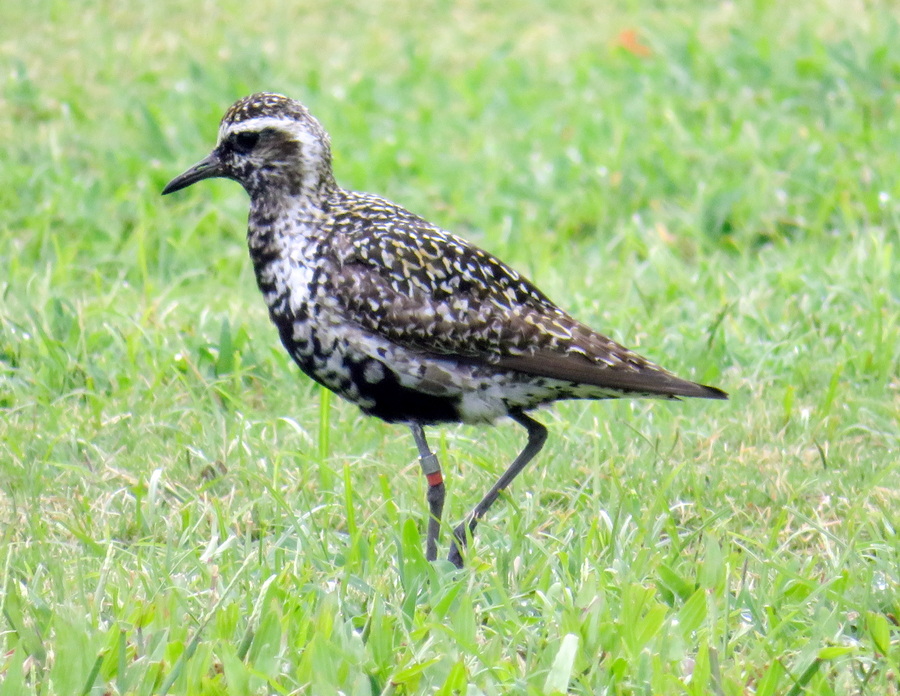
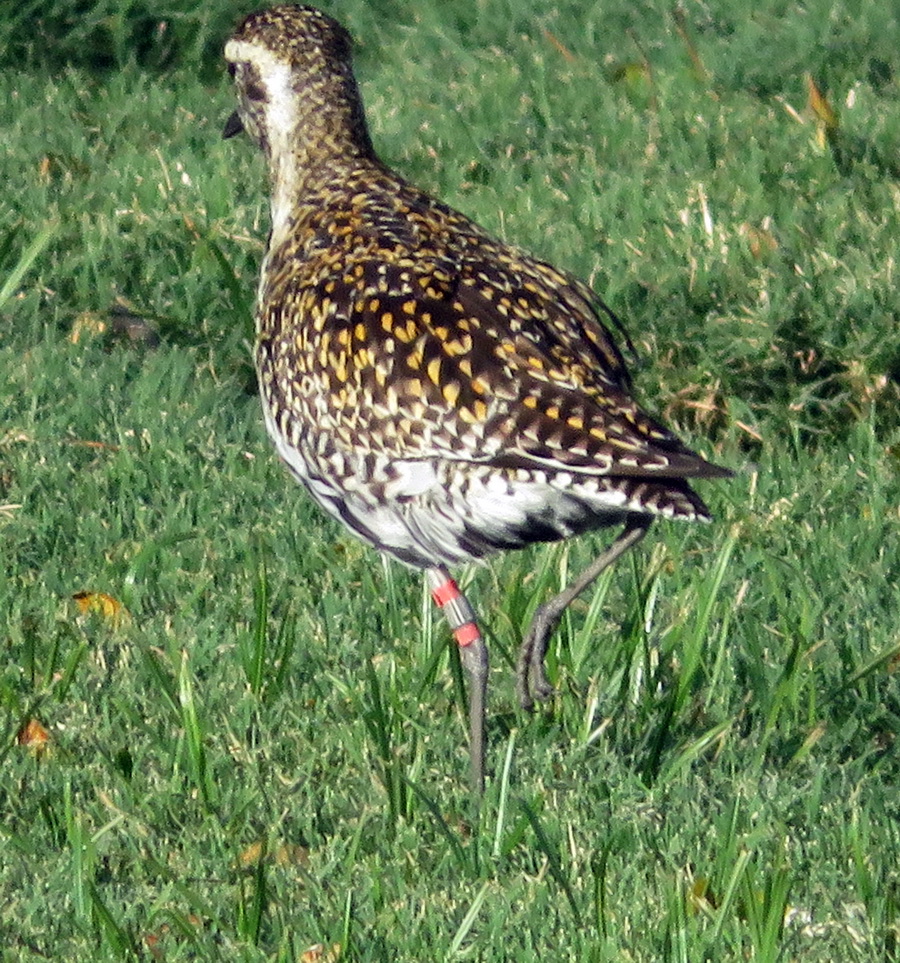 Mr. X in his territory in March, 2021 with all three leg bands. ©Sigrid Southworth.
 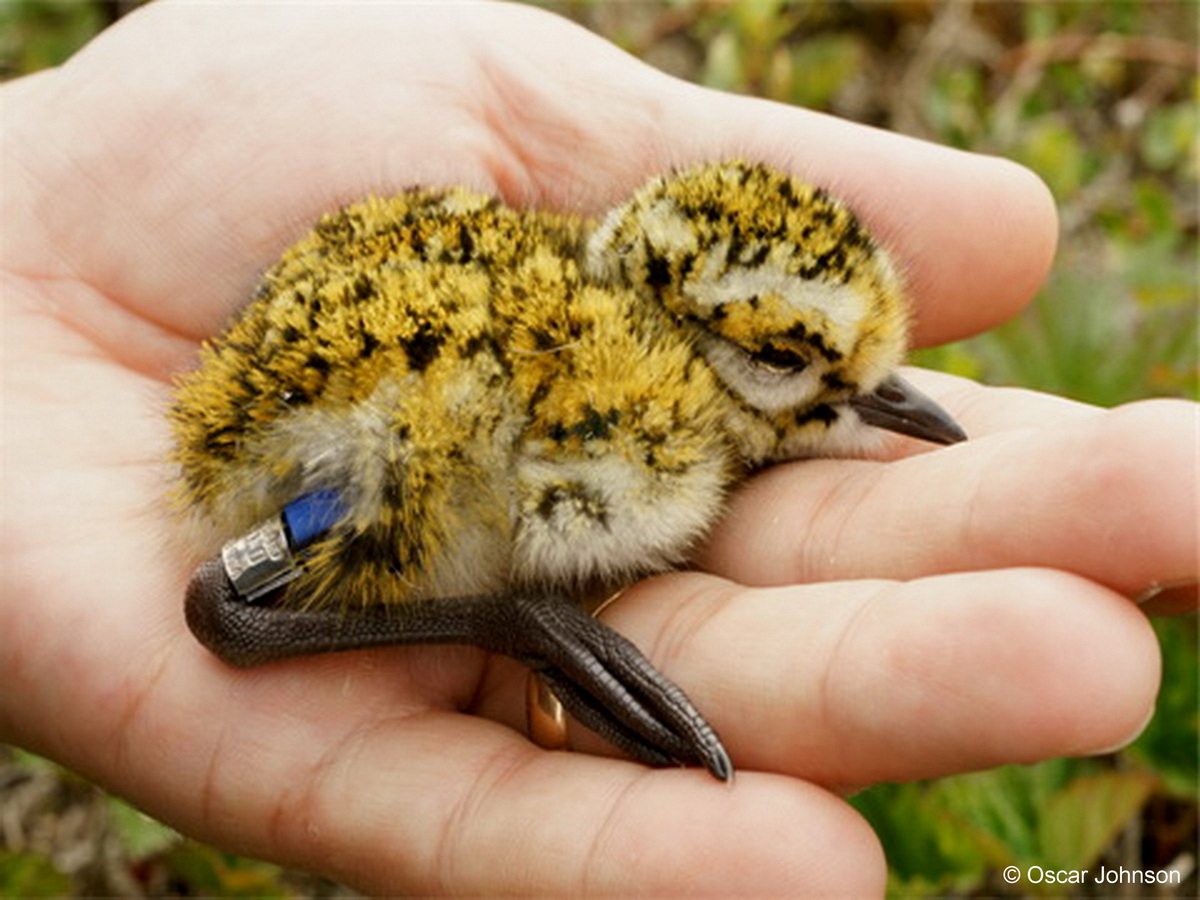 Researchers can place adult-sized leg bands, shown here, on newly hatched Kolea chicks. The youngsters begin foraging for insects and berries soon after hatching. Parents warm and protect their offspring, but do not feed them. Near Nome, Alaska © Oscar Johnson. …

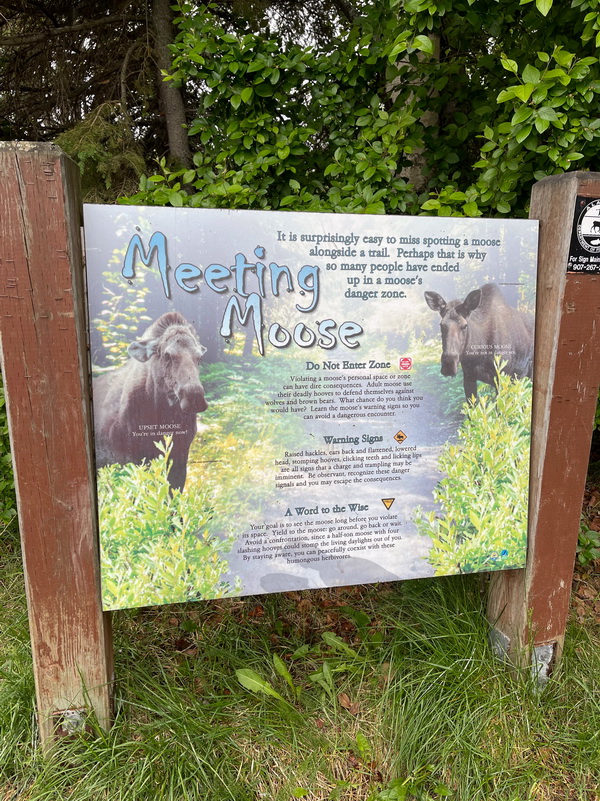 Signs on Anchorage’s Tony Knowles Coastal Trail explain how to behave when confronted by a moose. I thought such an encounter unlikely. I was wrong. ©Susan Scott
 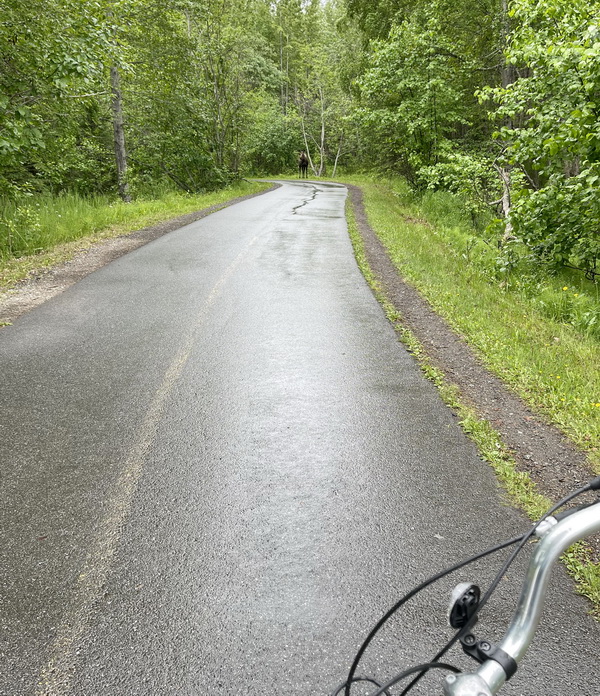 A moose on the trail brought me, on my rented bike, to a screeching halt. ©Susan Scott
 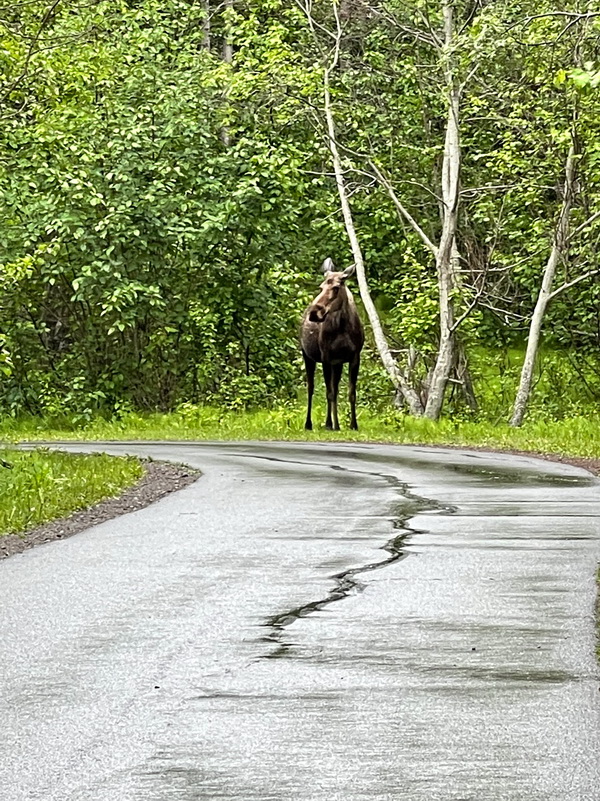 I waited until the moose lost interest in me and ambled off into the woods that border urban Anchorage. ©Susan Scott
 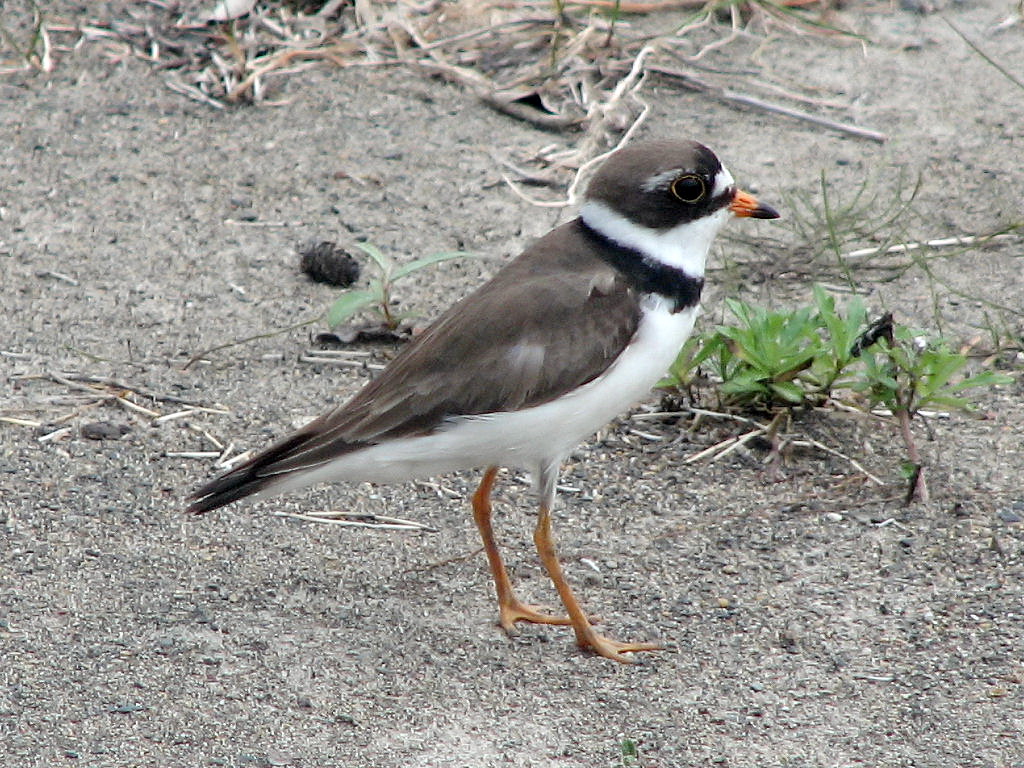 A clear picture of a semipalmated plover. D. Gordon E. Robertson photo, Creative Commons, Wikipedia.
 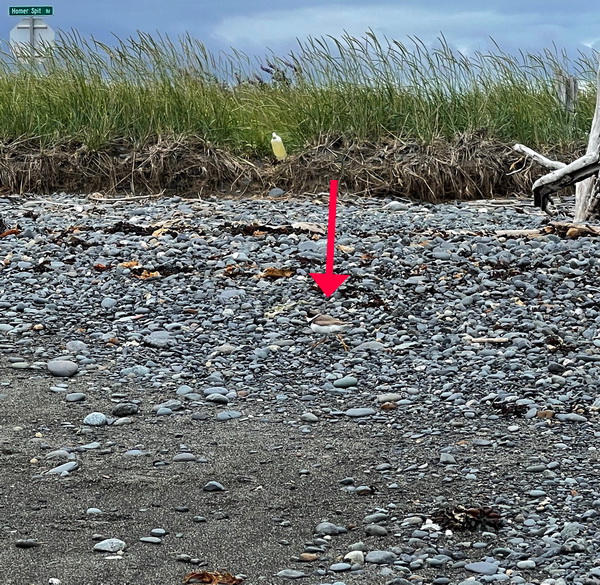 My first sighting of a semipalmated plover. This is just feet off the Homer Spit road (sign top left.) ©Susan Scott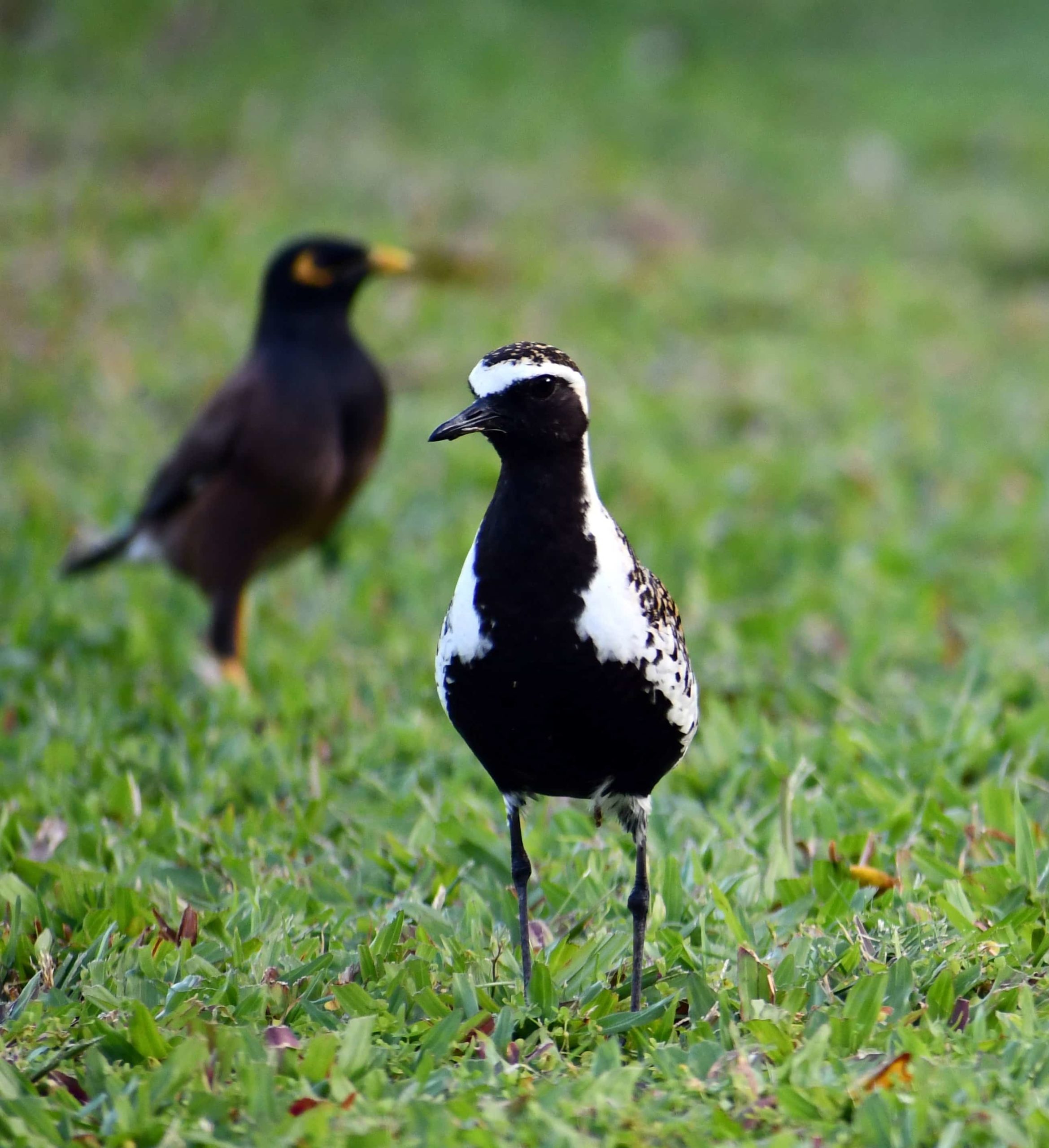
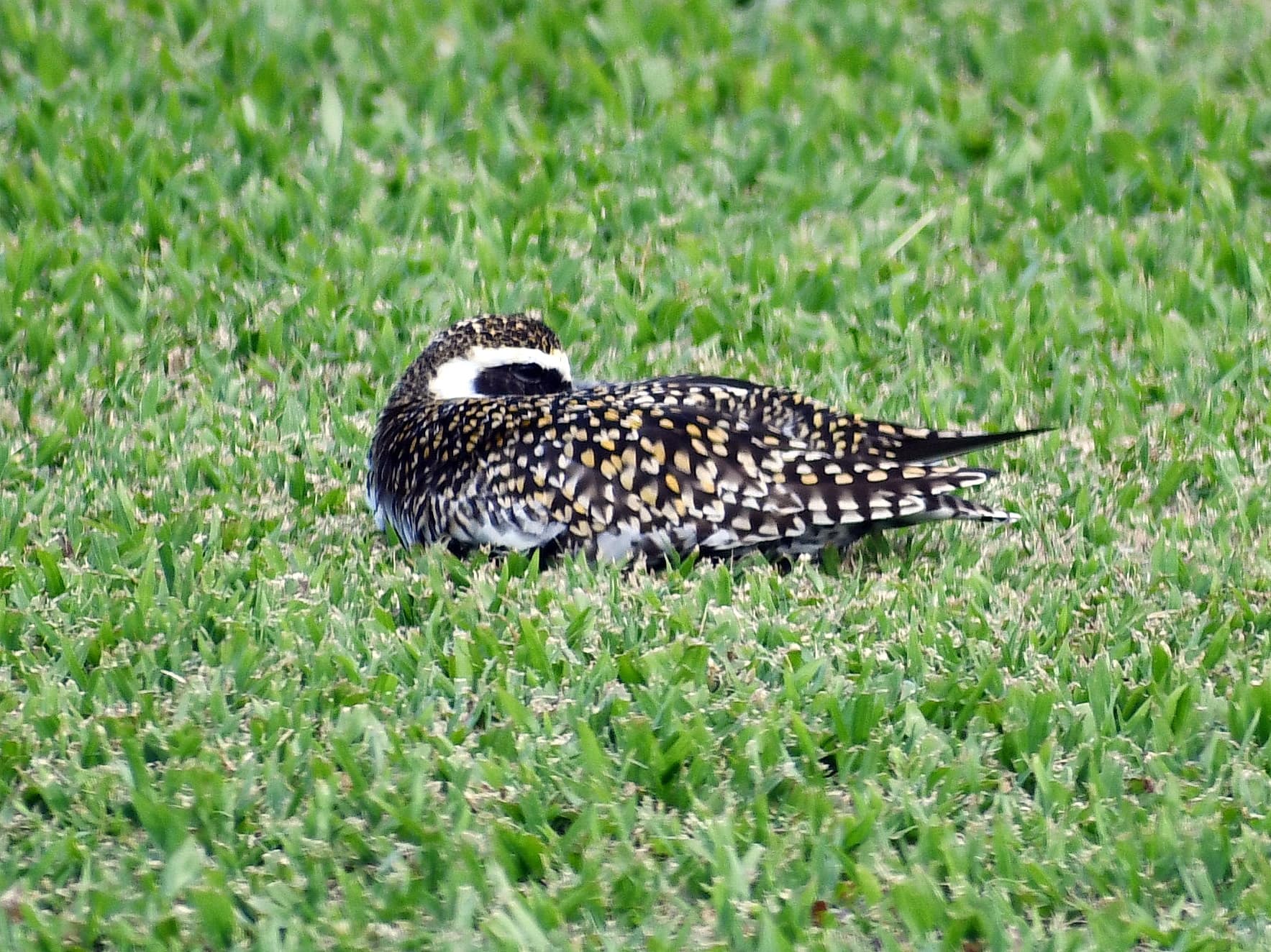 Resting up for the big trip. BYUH campus. ©Susan Scott